What does it take to turn AI experiments into measurable results in retail and supply chain operations?
AI Agents in Retail Supply Chains and Warehouse Operations
AI agents in retail supply chains are software applications that use operational data and connected tools to investigate problems, recommend responses and execute authorized tasks. Applications include resolving inventory exceptions, coordinating warehouse work, monitoring transportation and supporting customer order changes. Their autonomy depends on the product’s capabilities and the permissions configured by the business.
This article examines these applications for retailers, distributors and third-party logistics providers, including implementation requirements, human oversight, operating costs and methods for measuring business results. It also provides a framework for comparing vendors and products in this sector.
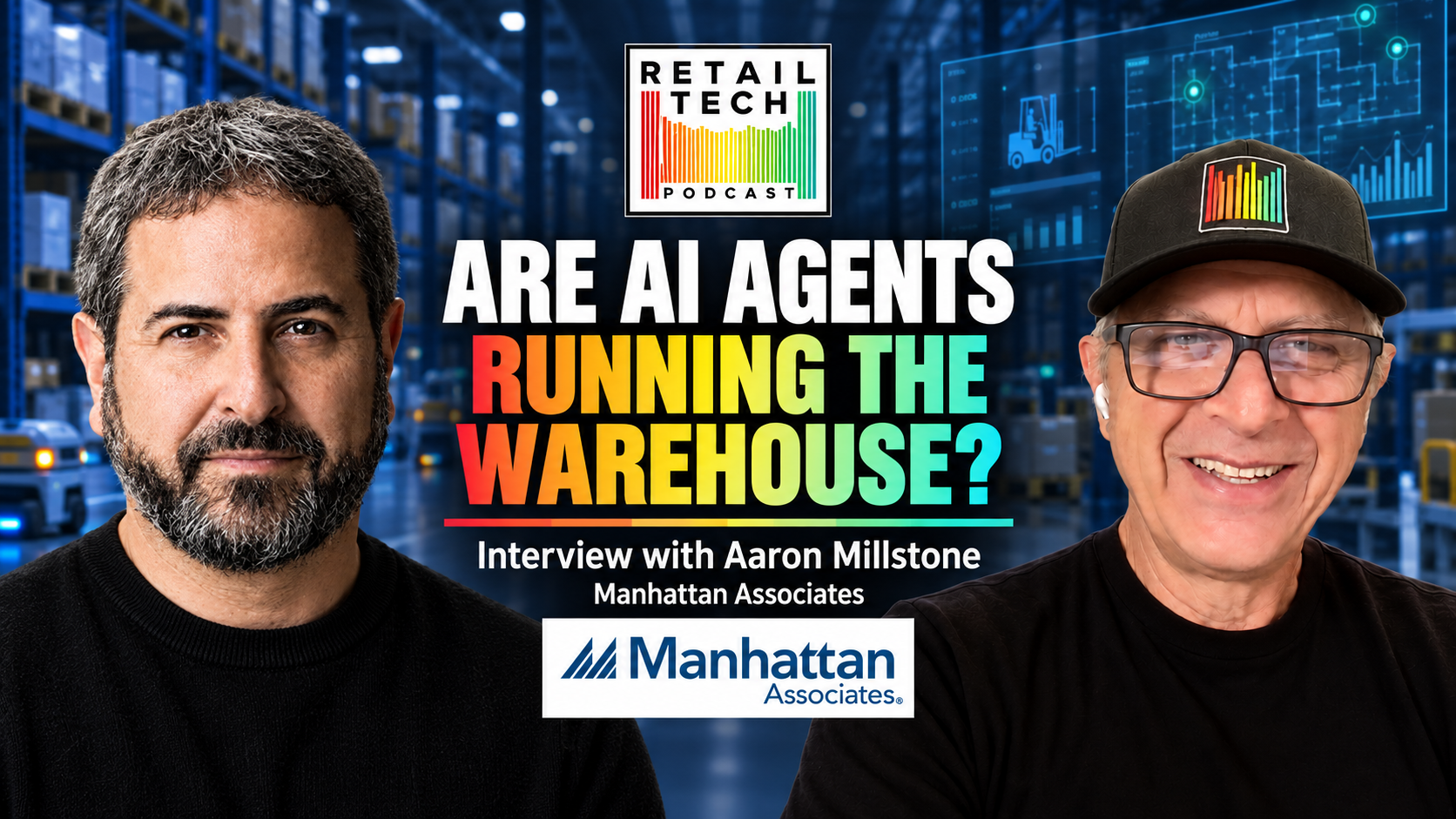
The discussion draws on a Retail Tech Podcast interview hosted by Darius Vasefi with Aaron Millstone, SVP of Customer Strategy and Applied AI at Manhattan Associates. Manhattan serves as one vendor example, with room for additional products, customer experiences and perspectives as coverage expands.
Where AI Fits in the Retail Supply Chain
A customer’s order depends on a sequence of connected activities. Inventory must be available, the right location must fulfill the order, warehouse or store employees must complete the work, and transportation must meet the delivery commitment.
Several categories of software support that process:
Warehouse management systems (WMS) coordinate receiving, storage, replenishment, picking, packing and shipping.
Order management systems (OMS) coordinate customer orders and fulfillment across channels and locations.
Transportation management systems (TMS) support shipment planning, carrier selection and transportation execution.
Planning systems help businesses forecast demand, replenish inventory and allocate products.
Store operations systems support inventory handling, customer service and fulfillment from physical stores.
AI capabilities may be embedded within these platforms or delivered through specialized products connected to them. The scope of an application—and its ability to access data and take action—depends on the product, implementation and customer’s permissions.
Practical Applications for AI
1) Inventory and fulfillment exceptions
An order may be delayed because an item is allocated elsewhere, waiting for replenishment, recorded incorrectly or still on a trailer.
AI can help gather the relevant information, investigate possible causes and guide a response. Where authorized, an agent may also execute corrective steps.
2) Warehouse work and resource coordination
Warehouse demand changes throughout the day. Different activities can become bottlenecks as orders arrive, inventory moves and employees complete their assignments.
AI applications can help teams identify imbalances, prioritize work and evaluate adjustments. Buyers should distinguish between systems that recommend changes and those capable of executing them.
3) Transportation and delivery management
Shipment delays can affect warehouse schedules, store replenishment and customer promises.
Potential applications include monitoring shipments, identifying delivery risks, supporting appointment changes and escalating exceptions. The important evaluation is how the product connects an identified problem to an operational response.
4) Customer service and order support
Service teams often need information from several systems to explain an order’s status or resolve a problem.
AI can help retrieve that context and support order changes, cancellations, returns and other service workflows. Each action requires appropriate access, business rules and controls.
What Makes an AI Agent Different From an Information Assistant?
An information assistant helps someone find or interpret information. An operational agent can also use tools to complete defined tasks.
There are several levels of involvement: answering a question, monitoring conditions, recommending a response, requesting approval and executing an authorized action.
A product may support different levels across different workflows. Calling software an “agent” does not establish how independently it operates.
For each use case, buyers should ask what triggers the agent, what information it can access, what it can change and when a person must intervene.
Why Architecture and Integration Matter
An agent’s usefulness depends partly on the systems it can reach.
Investigating a delayed order may require access to inventory, warehouse tasks, customer commitments and transportation schedules. Completing the response may require permission to update one or more of those systems.
This creates important differences between embedded platform capabilities and externally connected applications. Evaluation should consider data freshness, integration effort, access controls, failure handling and responsibility for maintaining those connections.
A compelling demonstration should show how the product works within the customer’s actual environment.
Combining AI Reasoning With Reliable Execution
Language models can interpret requests, investigate possible causes and help plan a response. Operational transactions also require precise rules and dependable execution.
In our interview, Aaron Millstone described Manhattan Associates’ approach as a “probabilistic brain and a deterministic spine.” AI helps reason through a problem, while defined software processes execute actions such as changing inventory availability.
The broader consideration applies when evaluating any vendor: understand where model reasoning is used, where established business rules take over, and how the system prevents an uncertain recommendation from becoming an inappropriate transaction.
Measure the Complete Workflow
An employee completing a task faster is useful, but the business impact depends on what happens next.
Does the operation ship more orders? Reduce overtime? Prevent missed departures? Improve service without adding capacity?
During our conversation, Aaron described a warehouse example in which AI reduced an investigation from approximately an hour to half an hour. Releasing work earlier could then affect employee utilization, shipping schedules and expedited freight requirements.
The example illustrates how a small improvement can affect several connected activities. Results should still be evaluated against a documented baseline, operating conditions and the full cost of deployment.
Useful measures may include order cycle time, on-time shipping, exception resolution time, overtime, fulfillment cost and service performance. The appropriate measures depend on the workflow being changed.
Human Oversight and Operational Responsibility
Autonomy should be defined at the level of individual actions.
A business may initially require employees to review recommendations, then authorize specific routine actions after testing their reliability. Other decisions may continue to require approval.
Deployment also creates ongoing responsibilities. Someone must investigate failures, review permissions, test updates and determine whether the agent continues to perform as intended.
Teams should understand how to pause an agent, reverse an action where possible and escalate a situation that falls outside its authority.
Vendors and Products in This Space
The following section covers vendors and products discussed or examined by Retail Tech Podcast. Each profile should be assessed against its specific use cases, deployment requirements and supporting customer evidence.
Manhattan Associates: Embedded Agents for Supply Chain and Commerce
Manhattan Associates provides software for warehouse management, transportation, order management and retail operations.
Its ActiveAgents offering provides ready-made AI agents, while Agent Foundry supports customer-specific agents and workflows within the Manhattan Active environment.
In our interview, Aaron Millstone, SVP of Customer Strategy and Applied AI, discussed engagements organized around roughly 90 days: establishing a baseline, introducing standard and custom agents, and measuring the changes.
The conversation also covered human oversight, model selection, operating costs, APIs and the organizational work involved in deployment.
How to Compare Supply Chain AI Products
A useful comparison begins with a specific operational problem. Products serving different workflows should not be treated as interchangeable simply because they all use AI.
For each vendor, establish:
Scope: Which process does the product support?
Data: Which systems and records does it need?
Actions: What can it execute, and what requires approval?
Implementation: What integrations, configuration and training are required?
Evidence: Which customers have deployed it, and how were results measured?
Cost: What are the implementation, subscription, usage and support costs?
Ownership: Who maintains the product, integrations and controls after launch?
These questions help connect product capabilities to the work needed to make them useful.
Model Selection and Ongoing Costs
The newest language model is not automatically the best choice for every operational task. Capability, accuracy, latency and cost need to be evaluated together.
Model changes can also alter behavior. Testing should therefore continue after initial deployment, particularly when a product changes its models, prompts, tools or workflows.
Operating costs include more than model consumption. Integration maintenance, employee support, monitoring and exception handling also contribute to the business case.
From Experimentation to an Operating Capability
AI in retail supply chains involves software, data, physical operations and people. A successful pilot is an important step, followed by the work of establishing repeatable performance and clear responsibility.
Start with a recurring problem, define the desired outcome, test within an appropriate scope and measure the complete workflow. Evaluate vendors on their ability to support that process over time.
As products develop, this article will expand with additional vendor perspectives, applications and customer examples.
Common Questions About AI Agents in Retail Supply Chains
What do AI agents do in warehouse operations?
AI agents can monitor warehouse activity, investigate inventory problems, recommend changes and execute authorized tasks. Applications include identifying why orders cannot be released, checking replenishment requirements and helping teams prioritize work.
How are AI agents different from traditional warehouse automation?
Traditional automation typically follows predefined rules and sequences. AI agents can add interpretation and reasoning when information is incomplete or conditions vary. They often work with existing automation and business rules to execute actions reliably.
Can supply chain AI agents act without human approval?
Some can execute specific tasks without approval each time, where the product supports it and the business authorizes it. Other actions require review. Autonomy should be evaluated separately for each workflow, including its permissions, escalation rules and consequences.
Do AI agents replace warehouse management systems?
They do not necessarily replace them. Agents may be embedded within a warehouse management system or connected to it through integrations. The underlying system continues to manage operational records and transactions, while agents help investigate conditions and coordinate authorized responses.
What data and integrations do supply chain AI agents need?
Requirements depend on the task. Investigating a fulfillment problem may require inventory records, order details, warehouse task status and shipment information. Executing a response also requires authenticated access to the relevant system functions.
How should retailers measure the ROI of AI agents?
Compare verified operational improvements with the full cost of implementation and ongoing operation. Relevant measures can include order cycle time, on-time shipping, exception resolution time, overtime and fulfillment cost. Establish a baseline and account for other changes that may affect results.
How long does it take to deploy supply chain AI agents?
There is no single deployment timeline. An embedded agent using existing data may require less setup than a custom agent spanning several systems. In this interview, Aaron Millstone describes Manhattan Associates engagements organized around roughly 90 days to establish a baseline, introduce agents and measure changes. That is an engagement approach, rather than a universal deployment estimate.
What should businesses compare when evaluating vendors?
Compare the supported workflows, required integrations, available actions, human approval controls, implementation effort, customer evidence and total operating cost. Ask vendors to demonstrate how their product handles a real exception, including what happens when it cannot complete the task.
Learn more about Manhattan Associates: https://www.manh.com
Explore more conversations and research at Retail Tech Podcast.

Interview with Lumana AI - Cameras That Think in Real Time
Interview with Firmly CEO Kumar Senthil on Solving the Integration Tax and the Journey to Zero-Code Merchant Connectivity

Interview with Portrait Displays VP of Marketing Marcel Gonska on Digital Display Oppportunities in Retail