Interview with Portrait Displays VP of Marketing Marcel Gonska: Bringing the Hollywood "Lens to Living Room" Experience to Consumers and retail opportunities
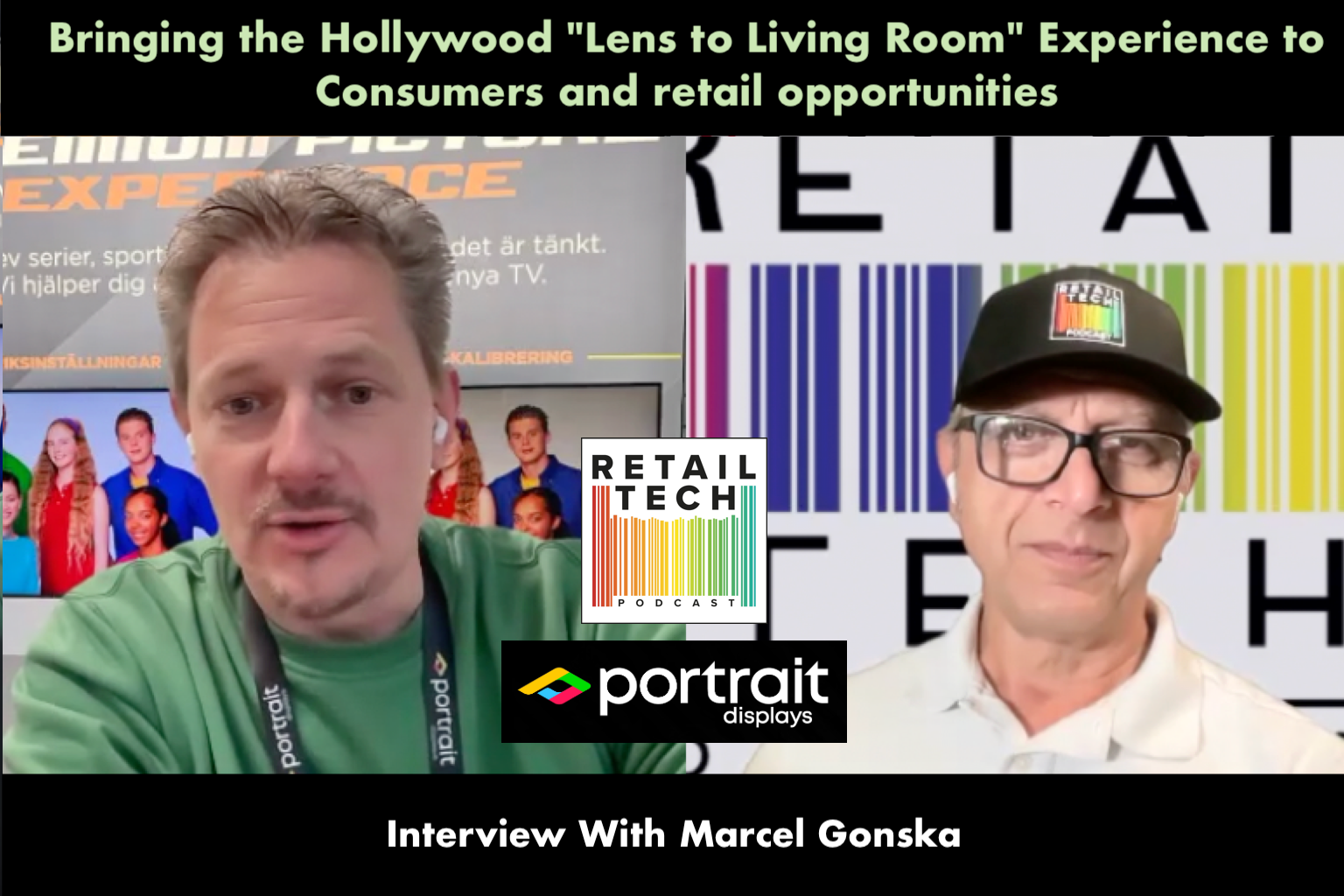
In this podcast interview, Marcel Gonska from Portrait Displays explains that most consumers fail to see movies as directors intended because retail televisions are typically poorly configured for home use.
He highlights that while professionals in Hollywood use Calman software to meet exact international video standards, most residential screens are set to exaggerated "store modes" that distort color and detail. To bridge this gap, Gonska proposes Calibration as a Service (CaaS), a business model that allows retailers to offer professional screen tuning as a value-added benefit.
This process utilizes automated software to adjust settings for different lighting environments, ensuring that the "creative intent" of filmmakers is preserved in the living room. By implementing these services in the United States, Gonska aims to democratize high-end picture quality for the average buyer.
Darius: Today I am excited to speak with Marcel Gonska, VP of Marketing at Portrait Displays. Marcel, you’ve been in the video business for nearly 30 years and with Portrait for over a decade. To start, could you tell us a bit about Portrait Displays and its roots?
Marcel: Portrait Displays is a software company based in Northern California, specifically the San Francisco Bay Area. We specialize in color correction, color control, and display control for everything that shows a picture, from TVs to monitors. Interestingly, our name comes from our origins 30 years ago when we designed software for old, bulky CRT monitors that could pivot from landscape to portrait format. Today, our most famous tool is Calman, which we acquired about 15 years ago. Calman is now the leading calibration solution in Hollywood, used by studios, on-set directors, and digital image technicians to ensure the artistic integrity of a film is maintained during production and color grading.
The Problem: The "Cranked to 11" Showroom Floor
Darius: Most consumers assume their brand-new digital TV is set up perfectly out of the box. Why is calibration even necessary for the average person?
Marcel: I would say 99% of people who get a TV out of the box are not seeing it the way it was actually meant to be seen. In the retail industry, TVs are often "cranked up to 11" just to scream at people on the showroom floor to gain attention against heavy competition. This results in pictures that are often too blue, too bright, or incorrectly saturated.
When you watch a movie like The Matrix, color is a storytelling tool—the directors used a light greenish tint to guide the audience. If your settings are wrong, you don't see those intended colors. A famous example is the "Long Night" episode of Game of Thrones; many viewers complained they couldn't see anything because their displays weren't calibrated to handle the dark, high-stakes cinematography. Calibration preserves the creative intent of directors like George Lucas or James Cameron.
Democratizing Quality: Calibration as a Service (CaaS)
Darius: You talk about a "Lens to Living Room" philosophy. How do you move this professional Hollywood technology into a standard retail environment like Costco?
Marcel: We want to democratize picture quality. While high-end home theater specialists have always offered calibration, they serve a tiny percentage of the market. To reach the masses, we developed Calibration as a Service (CaaS).
We partner with the "Big Seven" TV manufacturers—Sony, Samsung, LG, Panasonic, Philips, TCL, and Hisense—to build interfaces directly into their premium models that "talk" to our software. This allows for Auto-calibration, an automated process that is almost foolproof. It allows a retailer to calibrate all picture modes—Day, Night, HDR10, Dolby Vision, and Game mode—in one streamlined process that stores the settings directly on the TV's memory.
Darius: How is this actually implemented in a retail business model?
Marcel: We use a "train-the-trainer" model where we train a group of specialists within a retail chain who then scale that knowledge across their staff. There are three main ways this is performed:
1. Warehouse Calibration: The TV is calibrated in a distribution center and sold as a pre-calibrated SKU.
2. In-Store Calibration: The store unboxes the TV, performs the calibration, includes a calibration report to prove the value, and repacks it for the customer.
3. In-Home Calibration: A service provider comes to your house to calibrate the TV in your specific viewing environment.
The Calibration report alwas goes into the bot after calibration, also when the TV was calibrated in a warehouse.
In Europe, this has been a proven success since 2017, with 30 retail chains performing hundreds of thousands of calibrations. It helps retailers regain profit margins by offering a high-value service rather than just competing on hardware price.
Technical Standards and Future Trends
Darius: When a technician calibrates a TV, how do they know what the director wanted?
Marcel: Because standards are universal. Whether a colorist is working on a $40,000 reference monitor in Hollywood or you are watching a TV at home, the goal is to meet specific international standards like BT.709 (for HD) or P3 (for Digital Cinema). We calibrate the home TV to those exact same standards. We also adjust settings like gamma to ensure dark details remain visible in bright rooms without destroying the artistic intent.
Darius: Looking ahead, what should consumers be excited about in TV technology?
Marcel: We are seeing a massive shift toward RGB MiniLED and Quantum Dot OLED (QD-OLED). These technologies allow home TVs to get much closer to the highest standards set by professional laser projectors in IMAX or Dolby Cinemas. Soon, there will be a merger between cinema and home technology, where the experience in your living room is nearly indistinguishable from the studio master. Our goal at Portrait Displays is to ensure our software stays ahead of these standards so that "cinema at home" is a reality for everyone. For example, seeing a 100-inch MiniLED TV for $1,499 means true home theater is now accessible, making calibration even more vital to see the hard work that goes into modern content.
Key Takeaways:
Both consumers and retailers should recognize that we are entering a new era of home entertainment where the technical gap between the Hollywood studio and the living room is finally closing.
For the Consumer: See the Story as it was Written
The most important takeaway for listeners is that 99% of TVs taken straight out of the box are not showing the content as it was intended to be seen. While modern displays are more powerful than ever, they are often factory-set to be "too blue" or "too bright" to compete for attention on noisy showroom floors.
By choosing a calibrated display, you are ensuring that the artistic integrity and creative intent of directors like George Lucas or James Cameron are preserved in your home. Whether it is the specific greenish tint used to tell the story in The Matrix or the dark, high-stakes cinematography of Game of Thrones, calibration ensures you don't miss the details that the artists worked so hard to create. With the rise of affordable, massive screens like 100-inch MiniLED TVs, calibration is the final step to transforming a piece of hardware into a true cinema experience.
For the Retailer: A Proven Path to Profitability
For retailers, this conversation highlights a shift from competing solely on hardware price to providing high-value, specialized services. As hardware margins continue to decrease, Calibration as a Service (CaaS) offers a way to regain profit while significantly improving customer satisfaction.
The sources highlight that this is not a theoretical model; it is a proven success in Europe, where over 30 retail chains have performed hundreds of thousands of calibrations since 2017. By utilizing a "train-the-trainer" model and leveraging the automated "Auto-cal" interfaces built into the "Big Seven" TV brands, retailers can scale this service efficiently across their entire organization—whether through warehouse, in-store, or in-home implementations.
As technology moves toward a merger of cinema and home standards, the goal of the "Lens to Living Room" experience is becoming a reality. For retailers in the U.S. looking to lead this change, the sources suggest starting with pilot projects to see firsthand how professional calibration can drive both quality and revenue in a competitive market.

Interview with Lumana AI - Cameras That Think in Real Time

Interview with Firmly CEO Kumar Senthil on Solving the Integration Tax and the Journey to Zero-Code Merchant Connectivity

Interview with Steve Dennis on Retail Transformation and Leadership in 2025